
Ask a leadership team where AI is being used inside their business, and most will probably be able to name a few examples. Ask what rules govern that use, and they might not be able to answer.
AI has spread through most organizations faster than any policy to guide it, and that’s if there was even a policy in place to begin with. Decisions are already being made with tools no one formally approved, drawing on information no one formally cleared. So what rules should AI operate under, and who answers for the results?
For many growing businesses, that’s a governance question before it’s a technology one. It’s also the thinking behind Anderson Technologies’ view that governance is as important as innovation. A clear AI policy has become a leadership priority, not an IT formality.
This blog explores what a responsible AI policy should contain, who should own it, and how to build one without slowing the business down.
Governance Is What Lets You Say Yes to AI
While it might appear that an AI policy is a brake that slows the business down, the opposite tends to be true. A good AI policy is what allows a leadership team to say yes quickly. When the guardrails are already set, there are never disagreements and debates over what’s allowed and which data an AI tool can touch.
Think of it the way you’d think about spending authority. Clear limits and approval paths don’t stop a business from spending. They let it spend at pace, without the need for someone second-guessing every transaction. Governance does the same job for AI, which turns a few promising experiments into adoption that the business can repeat. That’s why responsible AI adoption tends to move faster inside organizations that set the rules early.
The practical question, then, is should those rules actually cover?
What a Responsible AI Policy Covers
A responsible AI policy needs to be clear on a few things, turning acceptable use, data access, and accountability into rules that your team can follow.
- It should say plainly what AI is approved for and what it isn’t, so no one has to guess which tasks and teams are in scope.
- It should define what information AI tools can access. Confidential client data, financial records, and proprietary information stay out of reach until the right governance and security controls are in place.
- It should name which tools are sanctioned and how someone requests a new one. A clear approval path pulls AI out of the shadows, because people route around rules only when there’s no sensible route through them.
- It should make a human accountable for every AI-assisted output. The tool can draft, suggest, and speed things up, but it can’t carry the accountability.
- It should set a review cadence. AI tools and the risks around them change quickly, so a responsible AI policy is a living document that’s updated on a regular basis.
That last point raises a bigger question. If a human owns each output, who owns the policy itself?
Who Owns AI Governance
The instinct is to hand AI governance to IT. It’s technology, so it must be IT’s job. But most of what a policy decides isn’t technical at all. What AI is for, how much risk is acceptable, and which information stays off-limits are all business judgment calls, not configuration settings. Your internal IT team can set up the controls that enforce those decisions, but they shouldn’t be the ones making them alone.
Governance needs a named owner at the leadership level: someone accountable for the policy existing, being followed, and being reviewed. In a large organization it might be a chief information officer (CIO) or a chief information security officer (CISO). Plenty of growing businesses don’t have that seat yet, which is precisely where a Virtual Chief Information Officer (vCIO) can help, since AI governance sits right at the intersection of budget, risk, and strategy.
Ownership means one person is accountable for the policy being followed and kept current. Without a clear owner, an AI policy tends to drift until the business is right back to AI running with no rules at all. The other half of ownership is control over what these tools can actually see.
Governance and Security Move Together
A policy decides what AI should be allowed to see. Security controls decide what AI actually can see. Those are two different jobs that need to line up in order for a responsible AI policy to work. Rules on paper mean little if the underlying permissions let a tool reach data the policy says is off-limits.
Microsoft Copilot is the clearest example. It works across the files, emails, and sites a user can already open, which makes it useful and easy to underestimate as a risk. If permissions have started to slip over the years, and they have in most growing businesses, Copilot can surface information far more widely than anyone intended. The fix requires getting access controls and permissions in order first, so what Copilot can reach matches what the policy allows. That’s the point where AI governance and cybersecurity stop being separate conversations.
Why This Is a Priority
The gap between how fast AI is being used and how fast it’s being governed is now measurable. In ISACA’s 2026 AI Pulse Poll, 90 percent of respondents said employees are using AI inside their organization. Only 38 percent had a formal, comprehensive AI policy in place.
In most organizations, AI adoption has outrun the rules meant to guide it. The encouraging part is the direction of travel. That 38 percent is up from 28 percent a year earlier, so leadership teams are gradually closing the gap.
For a growing business, that trend is the opportunity. Setting a clear policy now, while most organizations are still catching up, separates the businesses adopting AI with confidence from the ones still improvising. It’s also far easier to put sensible rules in place today than to retrofit them onto habits that have had another year to form.
Bringing Governance Into the Room at AI at Work
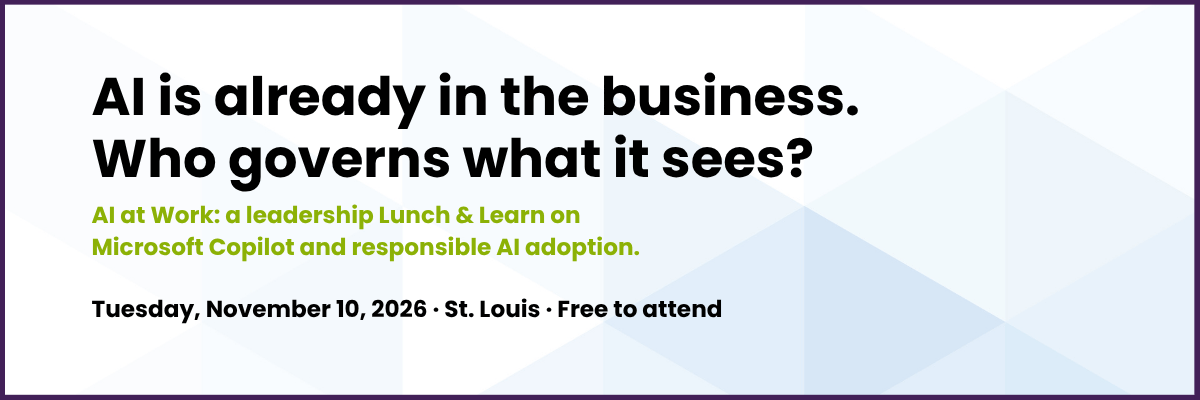
Building a responsible AI policy is easier with people who’ve done it before, and that’s the thinking behind our upcoming Lunch & Learn event. AI at Work (Where It Helps, Where It Doesn’t, and How to Start) will be held on Tuesday, November 10, 2026.
Over lunch, business leaders will gain a clear understanding of Microsoft Copilot and responsible AI adoption. That includes the governance and accountability questions this piece has walked through.
Attendees will see real workplace examples and leave with a framework for evaluating AI opportunities inside their own organization. They’ll also get a clearer sense of the rules that should sit around those opportunities.
If your leadership team is working out how to govern AI before it spreads any further, this is a practical place to start. By attending AI at Work, you’ll get:
- Direct access to Anderson Technologies’ AI advisory team to talk through what governance should look like for a business your size.
- A room of other leaders working through the same questions about policy, ownership, and accountability.
- A clear view of where Microsoft Copilot fits and what to get right before you switch it on.
- An open floor for questions specific to your organization’s data, systems, and industry.
Seats are limited, and the session is free to attend. If AI is already at work in your business and the rules haven’t caught up, this session is built to help you close that gap.
Reserve your seat today: https://andersontech.com/events/ai-at-work/
FAQs
What is an AI governance policy?
An AI governance policy is the set of rules that decides how AI can be used inside your business. It covers what AI is approved for, what information it can access, which tools are sanctioned, and who’s accountable for the results.
Who should own AI governance in a business?
AI governance needs a named owner at the leadership level, not just the IT team. The decisions it rests on, like acceptable use, risk tolerance, and what data AI can access, are business judgment calls. Larger organizations might assign a CIO or CISO, while growing businesses often lean on a vCIO, since governance sits across budget, risk, and strategy.
What should an AI acceptable use policy include?
A clear AI acceptable use policy should spell out what AI is approved for, which tools are sanctioned, and what information those tools are allowed to touch. It should also name a human accountable for AI-assisted outputs and set a schedule to review the policy as tools change.
Does Microsoft Copilot need a governance policy?
Yes. Microsoft Copilot works across the files, emails, and sites a user can already access, so Microsoft Copilot governance comes down to getting permissions right first. Without that, Copilot can surface information more widely than anyone intended.
How is AI governance different from AI security?
They work together, but they aren’t the same thing. AI governance decides what should be allowed, including which tools, which tasks, and which data. Security controls enforce what actually can happen through permissions and access controls. A responsible AI policy only holds up when both are aligned.