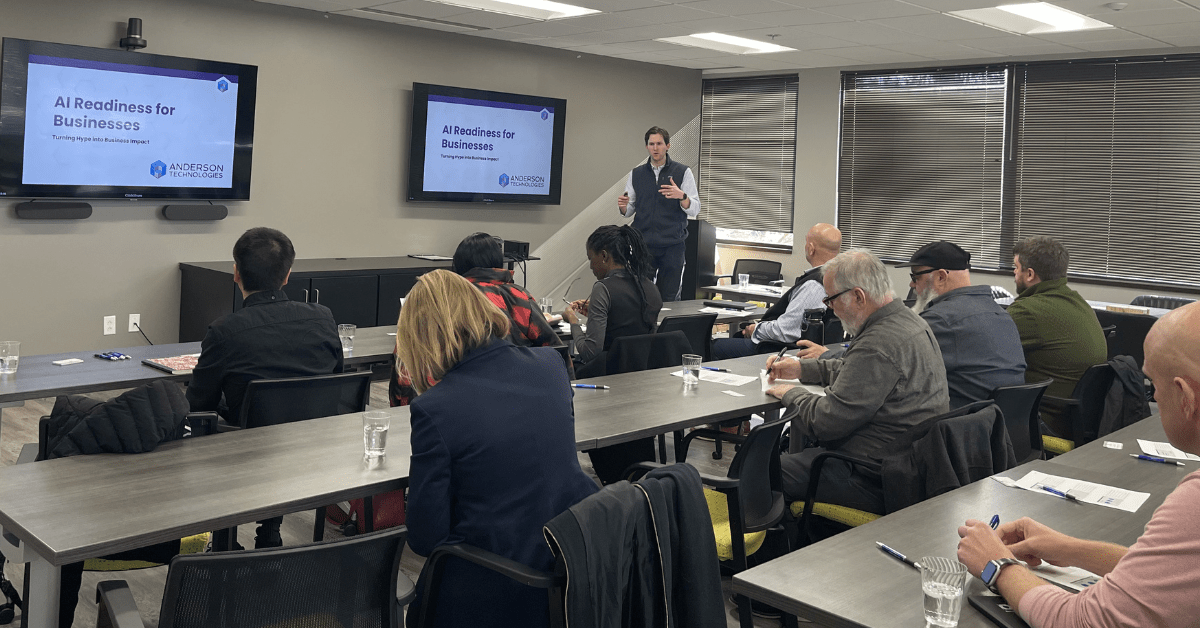
Anderson Technologies recently hosted a lunch and learn event where we discussed AI readiness for businesses. The conversations that came out of it proved just as valuable as the presentation itself. The session brought together local business leaders to answer burning questions and enhance their understanding of what AI actually means for their organizations.
Because right now, most business owners aren’t asking whether AI matters. They’re asking where it fits, how to start, and whether the investment is even worth it. It’s still an area of technology that’s (understandably) met with skepticism and apprehension. These are the questions that shaped this session, and the answers offer a useful framework for any growing business thinking about where AI belongs in their strategy.
Implementing AI Isn’t About Overhauling Your Business Overnight
One message resonated more than any other during the session: AI done right isn’t about transforming your entire operation in one go. It’s about identifying small, repeatable processes and making them more efficient–then letting those incremental gains compound over time.
Think about it this way: If contract review currently takes an hour but AI can help your team do it in 15 minutes, that’s a meaningful time saver on its own. Now add in sales follow-ups that used to eat 15 minutes each, four times a day. Stack those kinds of efficiencies across a team of 10 people, and you’re looking at 20 or more hours reclaimed every week. And that’s all without changing the way your business fundamentally operates.
That’s the point where attendees really started engaging. Rather than asking about the technology itself, the conversation shifted toward their own workflows. People were identifying processes their teams repeat daily and asking whether there was a way to streamline them. The answer, more often than not, was yes, and it didn’t require a massive investment or a complete rethink of how they run their business.
The takeaway is a simple one: start small, let the productivity stack up, and build from there.
Why “95% of AI Projects Fail” Doesn’t Mean What You Think
One of the most discussed moments across the session came from a stat pulled straight from the MIT State of AI in Business report: 95% of enterprise AI pilots delivered no measurable ROI. On the surface, that’s a pretty worrying headline. It’s the kind of thing that fuels the narrative that AI is overhyped and underdelivering. But when you dig into what’s behind that number, the picture changes.
What the Headline Doesn’t Tell You
Many the deployments included in that statistic weren’t failures of AI as a technology. They were failures of readiness. Common issues behind that 95% figure include:
- Unclean or poorly structured data that gave AI nothing reliable to work with
- No clear strategy or ownership guiding how AI was being deployed
- Isolated pilot programs measured in small groups rather than across the organization
In other words, AI didn’t fail these businesses–a lack of preparation did.
The Headlines Cut Both Ways
This led to a broader theme that ran through the event.
Some headlines overstate what AI can do: no, it’s not replacing your workforce anytime soon.
Others overstate its limitations: no, it’s not a bubble or a waste of money either. The reality sits somewhere in the middle, and that middle ground is exactly where most businesses should be operating.
The bottom line? AI is more accessible and more practical than most of the coverage suggests. But you get out of it what you put in – and that starts with making sure your business is actually ready for it.
What Business Leaders Were Asking About AI
Perhaps the most telling part of our Lunch & Learn event was what people wanted to talk about. The most common questions weren’t about specific AI platforms or the finer points of machine learning. They were far more practical: Where do I start? What are the quick wins? How do I know if my business is even ready for this?
Where the Real Value Is Showing Up
The use cases that generated the most interest aligned closely with where businesses are already seeing returns from AI:
- Contract and document automation — reducing hours of manual review to minutes
- Email drafting and sales follow-up — cutting repetitive writing tasks that eat into every day
- Customer call summarization — capturing key details without relying on notetaking
- Analytics and reporting — surfacing insights faster without waiting on manual data pulls
Some attendees were further along than others. One had built agentic workflows using Microsoft Copilot Studio to automate contract renewal reminders – a process that would typically rely on a CRM but was handled entirely through AI.
The common thread? Real ROI comes from targeting repetitive, time-consuming workflows, not from chasing the flashiest new tool on the market.
Why These Questions Are Important to Ask – Even If You Weren’t in the Room
The questions raised during the session aren’t unique to the people who attended. They reflect conversations happening inside businesses of all sizes right now, and if your organization hasn’t had them yet, it’s worth starting sooner rather than later.
One theme that came up repeatedly is the importance of AI readiness before adoption. AI deployed without clean data, clear governance, and proper security foundations is where the real risk lives. That’s not a reason to avoid AI, but it is a reason to make sure you’re building on solid ground before you start.
There’s also the reality of shadow AI to consider. Your team is very likely already using tools like ChatGPT or Claude in their day-to-day work, whether it’s officially sanctioned or not. Rather than trying to block that practice entirely, the smarter approach is to get ahead of it so you can put clear policies in place, establish boundaries around data use, and channel employee enthusiasm for AI into something structured and secure.
Start the Conversation
These are exactly the kinds of strategic conversations we have with our clients every day – not just about which tools to deploy, but about building the foundations that make technology work for your business. Whether that’s getting your data in order, establishing AI governance policies, or identifying the workflows where automation can make an immediate difference, it starts with understanding where you are today and where you want to go.
And this is just the beginning. We’ll be continuing to bring these conversations to the St. Louis business community and beyond in the future, with more events and speaking engagements on the horizon. Keep an eye on our events page and our socials for future announcements.
If you’re thinking about where AI fits into your business, or you want to make sure your IT environment is ready for what’s next, we’d love to help you figure out the right next step. Schedule a consultation today, and we’ll help you get your business AI-ready.